










At the beginning of the year, before the outbreak of conflict in the Middle East, the outlook for the global economy was positive.
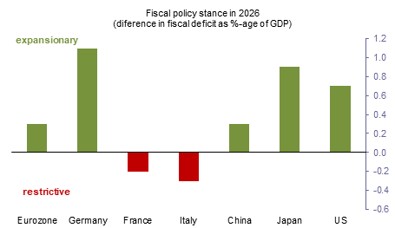
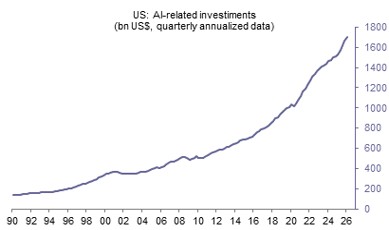
The first quarter had actually started well, with a strengthening of growth in the major economies, partly thanks to the support of fiscal stimulus measures, particularly in Germany, but also in the United States and China and a boom in technology investments, especially in Artificial Intelligence (AI).
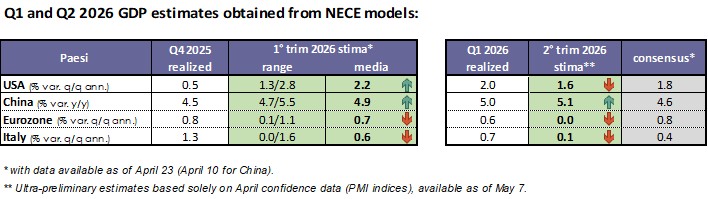
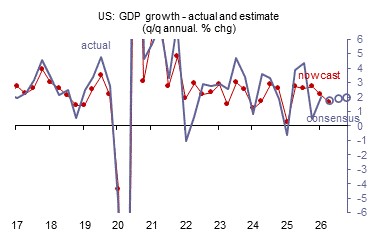
In particular, US GDP picked up the pace at the start of the year, growing at an annualised rate of 2% quarter-on-quarter, well above the meagre 0.5% recorded in the previous quarter. This is primarily due to the strengthening of investments and the reopening of government offices following the end of the shutdown, which had depressed growth during the final quarter of last year.
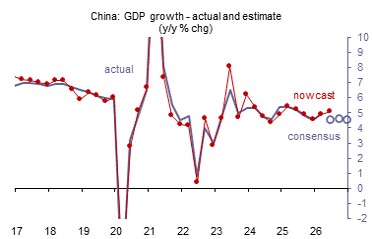
Although less pronounced, GDP growth in China is also accelerating, at +5% year-on-year, above the 4.5% recorded in the previous quarter, thanks to sustained export momentum as well as a recovery in domestic demand. This has affected both consumption, which has benefited from the boost of Lunar New Year festivities, and investment, supported by government fiscal stimuli.
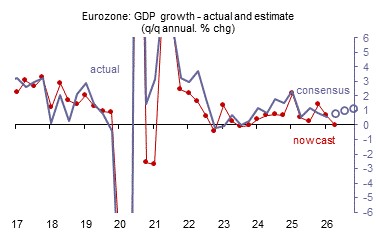
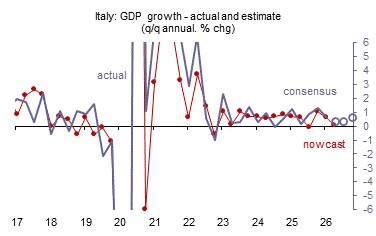
The Eurozone also showed resilience at the start of the year, growing by an annualised 0.6% quarter-on-quarter, just below the 0.8% recorded in the previous quarter, supported by accelerated activity in Germany (+1.3%), which benefited from the government stimulus, and sustained growth in Spain (+2.5%) and Italy (+0.7%).
These data have largely confirmed the indications provided by the NECE models.
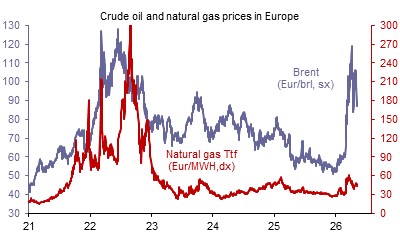
Looking ahead to the second quarter, the growth outlook is nevertheless deteriorating, due to the ongoing energy shock caused by the conflict in the Middle East and, in particular, the blockade of the Strait of Hormuz.
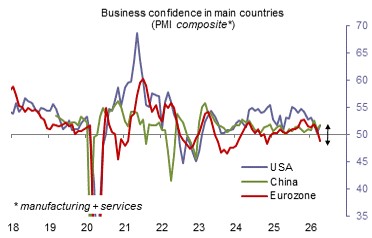
The deterioration in growth prospects is most evident in the Eurozone, which is more dependent on the flow of oil and gas imports from Gulf countries. April’s confidence data (PMI indices) showed a marked deterioration. Based on these (and in the absence of other data for the quarter so far), NECE models indicate GDP stagnation at the beginning of the second quarter.
By contrast, for the US, the signals from PMIs have been more reassuring, indicating that growth is likely to hold at a pace only slightly lower than that recorded during the first quarter, also supported by upcoming fiscal incentives from the government.
Further signs of sustained growth have also come from China, where April PMIs have remained on average at levels consistent with GDP growth close to the 5% recorded in the first quarter.
Clearly, given the very limited data available, the indications derived from the NECE models are extremely preliminary with regard to economic trends, the outlook for which could change rapidly depending on the evolution of the conflict in the Middle East.
For this reason, central banks have signalled their intention to adopt a prudent approach to monetary policy, taking time to assess the duration of the conflict and the resulting energy shock before deciding what action to take on interest rates.
APPENDIX ON METHODOLOGY
NECE (Now Economic Cast by Eurizon) estimates are obtained using the Nowcasting econometric estimation technique.
This technique allows for very short-term, practically real-time forecasting of GDP growth, which is a quarterly figure typically released with a delay of about 1 to 1.5 months after the end of the reference quarter. Forecasts are obtained by leveraging information from higher-frequency economic data (typically monthly), which are made available during the quarter being forecast and thus in advance of the GDP data, at least in its initial estimate. As the term ‘now’ suggests, the estimate concerns the current situation, i.e. GDP performance in the current quarter or, in any case, the quarter to which the published monthly data relate. The term ‘forecasting’ typically refers to longer-term estimates.
Forecasts made using the nowcasting technique change as new relevant information becomes available, becoming increasingly accurate as data for the quarter being estimated are released, while remaining ‘forecasts’ and therefore subject to error.
Information can consist of either qualitative data, such as business and consumer confidence indices (soft data), or real activity data (hard data), such as industrial production, consumption, trade balance data and order books. Lastly, some models are constructed using both types of data (mixed models).